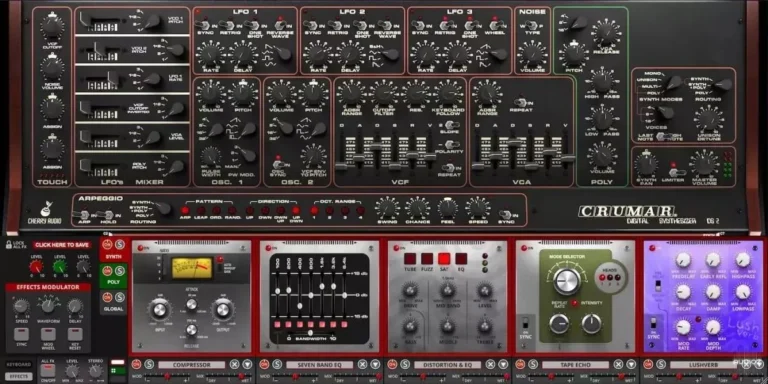
The Crumar DS-2 synthesizer from Cherry Audio accurately reproduces the unique digital/analog sound of the 1978 hardware synthesizer. This latest collaboration with our friends at Crumar Instruments not only captures the unique timbre and multitimbral capabilities of the original, but enhances them, offering an impressive combination of innovation and authenticity.
The original Crumar DS-2 featured a monophonic synthesizer engine combined with a 44-note fully polyphonic (paraphonic) section, creating a unique musical experience when used together. “DS” stood for “Digital Synthesizer,” and it was indeed an early hybrid synthesizer, featuring two digitally controlled oscillators (DCOs) as well as analog LFOs, VCFs, VCAs, and EGs. But these weren’t the DCOs we’d come to know in later polyphonic synthesizers.
To avoid the tuning issues of traditional analog synthesizers, Crumar applied an advanced concept to the synthesizer section to create drift-free oscillators. However, the resulting waveforms were fully stepped, creating a rough timbre and wild harmonics.
The Poly section was paraphonic, with a single filter (with high- and low-pass controls) and its own VCA. It created unique sawtooth waves by combining down-splitting square waves with resistors and high-pass filtering. The cutoff, resonance, and modulation settings in the Synth section were also applied to the paraphonic polyfilter.
As a result, the DS-2’s timbres differ from both the smooth, polished sounds of most digital synthesizers and the warm, oily tones characteristic of classic analog models. Instead, the DS-2 possesses a sharp, harmonically incisive quality and a rugged character that sets it apart from the crowd.
Peculiarities
Based on the 1978 Crumar DS-2 , which featured a monophonic DCO synth engine paired with a 44-note fully polyphonic (paraphonic) section, dual LFOs, a 24dB 4-pole VCF, dual ADSR-EGs, and a hardwired five-part LFO mixer.
Enhanced synth section: monophonic mode with last/high, unison, and multi-voice controls (including voice cycling, panning, and tuning). Polyphonic capabilities with 4, 8, or 16 voice options.
Improved polyphonic section: now fully polyphonic, supporting up to 32 notes.
In addition to the layer mode, there is a key split mode for the synth and polytone generators with adjustable ranges for both splits and layers.
Two oscillators based on the original’s digital oscillators, with stepped waves for sawtooth, triangle, square, and pulse waves. OSC 2 in the Synth section now includes a corresponding stepped sine waveform.
Added oscillator synchronization
A third LFO has been added to the original two, offering ramp, triangle, sine, square, sample and hold, and ladder waveform options.
The LFOs have been improved with discrete delay knobs for each, replacing the previous global delay knob.
LFOs now include sync, re-trigger, and one-shot, as well as reverse wave options for LFOs 1 and 2.
The LFO Mixer, which was originally connected to OSC 1, OSC 2, VCF, VCA, and Pulse Width, now has six assignable destinations with 33 options each.
Envelopes (DADSR) have been updated with a delay start stage and rate, and contour envelopes are now available. Polarity has been added to the VCF EG.
VCA release control is enabled in the Poly section
Touch Control offers four slots with simple assignment functionality, allowing channel-based or polyphonic aftertouch control with compatible controllers.
VCF now offers both 12dB 2-pole and the original 24dB 4-pole options, with the addition of polarity and keying.
Assign a bend range to the pitch and add a separate mod wheel control.
A dynamic arpeggiator for one or both parts, with four pattern modes – Arp, Leap, Order, Random – with swing, chance and feel, adding a degree of randomness to arpeggios.
Three independent, customizable effects chains—one each for the Synth and Poly sections, plus a global layer with a separate effects modulator for each layer.
20 studio effects that can be arranged, saved, and recalled in your effects chains, interchangeable with modern Cherry Audio synthesizers:
BBD Flanger, Compressor, Digital Delay, Digital Reverb, Distortion & EQ, Dual Delay, Dual Ensemble, Dual Phaser, Envelope Filter, Flanger & Chorus, Galactic Reverb, Lo-Fi, Lushverb, Ring Modulator, Sevenband EQ, Spring Reverb and Tape Echo. New to the Mercury-8 are DCO Chorus, Panner and Pulser.
Mini-interface for effects control with on/off, solo, bipolar modulator amount slider, and dry/wet mix for each effect. Global effects on/off, leveling, and stereo widening
Separate virtual instruments and plug-ins are included
User-adjustable oversampling control
Full MIDI control and DAW automation for all controls with easy-to-use MIDI learn and mapping (preset and global)
Cherry Audio’s popular Focus Zoom feature, along with standard drag-and-drop UI zooming and resizing
- Download Cherry Audio – DS-2 v1.0.3.38 SAL,VSTi, VSTi3, AAX x64 [1.04.2026](R2R)
- Original Publisher: Cherry Audio
- Version: v1.0.3.38
- Format: VSTi, VSTi3, AAX, Standalone
- Category: VST Plugins, Virtual instruments and synthesizers
- Require: Windows 7 or higher & R2R System
- License type: Full
- Download Size: 185.7 MB
is there a reason all Cherry Audio vsts lately are not working? Mercury-8 too… “please make sure it’s installed correctly” when i try opening in DAW after installing the way i always install VSTs.
I just get a cherry audio splash screen in 3 DAW’s and the standalone .exe