Based on the renowned Siemens W295b Class-A discrete equalizer from the 1970s, it’s known for its incredibly airy highs and voluminous bass. A very welcome improvement over its predecessor!
Features of the Siemens W295b and Telsie S:
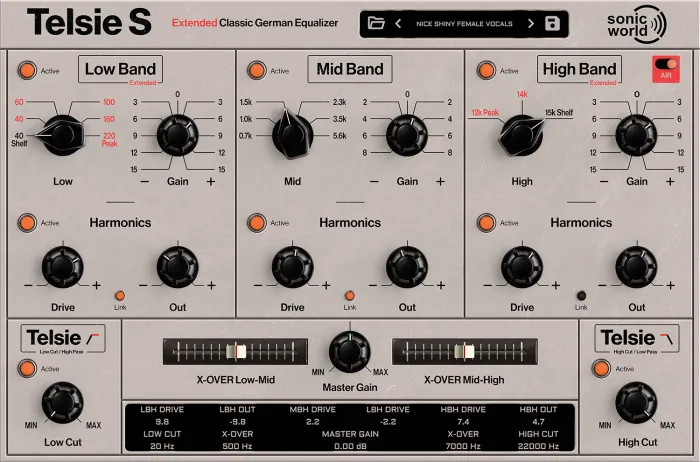
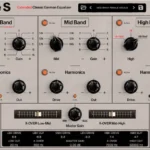
Like the original hardware, the Telsie S features a three-band equalizer with high- and low-frequency shelving filters and a peaking filter at midrange frequencies. The low-pass filter has a value of ±15 dB at 40 Hz, and the high-pass filter has a value of ±15 dB at 15 kHz.
The mid-frequency filter is a presence/absence filter with peaking characteristics and six selectable center frequencies: 0.7 kHz, 1 kHz, 1.5 kHz, 2.3 kHz, 3.5 kHz, and 5.6 kHz, with a maximum boost and cut of 8 dB each. This peaking filter has a proportional Q factor, meaning the more dB you boost or cut, the narrower the flare width.
Low-pass filter with additional frequencies:
As an alternative to the original device’s low-pass filter at 40 Hz, additional peak filter frequencies are provided with center frequencies at 40, 60, 100, 160, and 220 Hz.
These peaking filters have a proportional Q factor, meaning the flare width narrows further the more dB you raise or lower. These additional peak frequencies give the filter significantly more sonic flexibility than the original 40 Hz shelving filter.
High-pass filter with additional frequencies and AIR switch
The high-frequency range utilizes a unique, highly pleasing high-pass filter at 15 kHz. Alternatively, the Telsie S also offers two additional peaking filters centered at 12 kHz and 14 kHz, with a maximum boost or cut of 15 dB in 3 dB increments.
The AIR switch significantly expands the high-frequency range. You can experiment with a higher sampling rate to make this effect even more noticeable.
Harmonic function:
Each of the three EQ bands has a harmonics function with two parameters: “On” and “Off.” The volume control adjusts the amount of harmonics added to boost the signal. You can use the Out volume control to compensate for the volume increase caused by the volume section. By default, these two parameters are linked. You can disable this with the Link switch.
Please be careful when doing this, as extreme amplification is possible. Excessive amplification can damage not only your ears but also your equipment. We are not responsible for any damage.
Low-pass, high-pass filter and high-low-pass filter:
The High Pass and High Cut filters are used to clean up the frequency range of your signal. For example, low-frequency rumble on an acoustic guitar or vocal track can be easily reduced with the Low Cut filter, or you can reduce the high frequency range to remove unwanted frequencies. You can also use both filters to make room for other tracks. The cutoff frequency can be freely selected; both filters have a smooth slope of -12 dB per octave.
Low/Mid Range and Mid/High Range Images
The analog W295b’s high- and low-range curves are extremely broad. This means that boosting or cutting frequencies in the 40 Hz range has an audible effect up to approximately 2 kHz. In the 15 kHz range, boosting or cutting frequencies has an audible effect at approximately 200 Hz.
We’ve never found this characteristic appealing, as it often leads to unwanted frequency processing, even if you only want to boost or cut frequencies at much higher or lower frequencies.
Main Boost and Parameter Panel
The master gain is used to compensate for level differences caused by equalization or harmonics. Pressing the master gain knob resets it to 0 dB.
The parameters panel displays the set values of three harmonic ranges: LBH (Low Harmonics), MBH (Mid Harmonics), HBH (High Harmonics), low and high pass filters, the selected frequencies of the two X-overs and the set gain.
- Download SonicWorld – Telsie S v1.1.1 [SEnki] VST3|AAX [WIN] [02/18/2026]
- Original Publisher: SonicWorld
- Version: v1.1.1
- Format: VST3, AAX
- Category: VST Plugins
- Require: Win 11+
- License type: Full
- Download Size: 29.8 MB