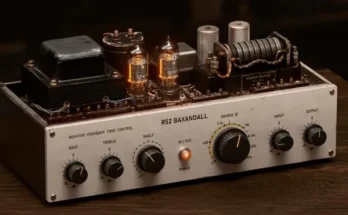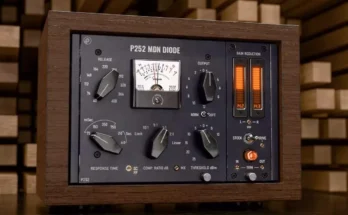
In the original amplifier, the signal passes through one valve at the input and another at the output, with a passive equalizer between them. In the ESTER amplifier, what these valves do when you adjust them—the density, the harmonics, the way the sound changes when pressed and then takes a while to return to its original state—is combined into a single vacuum tube stage before the equalizer, like in a preamplifier, preserving the characteristics of both tubes historically used in the original amplifier.
This placement is deliberate. If the valve were placed after the EQ, it would cut harder each time you boosted the gain, forcing you to adjust the saturation each time you touched a particular band. With the valve placed before the EQ, color and timbre become two separate parameters: set the drive once with INPUT TRIM, then freely adjust it with the EQ. The saturation level remains as you set it, the curves remain exactly where you set them, and the EQ can also shape harmonics—HIGH CUT can smooth out the harshness added by hard drive, while LOW CUT can reduce the weight it creates.
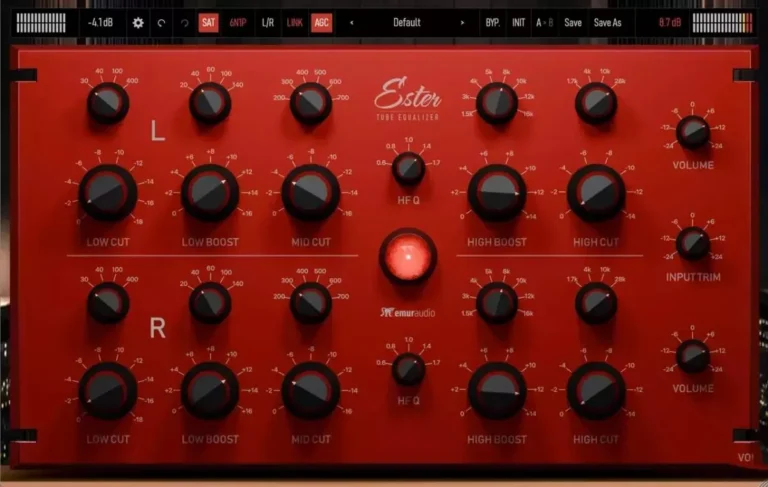
The tube between the channel rows is the amplifier’s own meter, displaying the actual harmonic product being generated. SAT disables the entire amplifier without affecting its settings.
Two lamps, two chapters of history
The two tubes played by ESTER are the 6072A and the 6N1P
A slot on the top panel switches the amplifier between the two tubes, which sound different. The 6072A kicks in earlier and gradually builds volume across the entire INPUT TRIM range. The 6N1P stays clean for longer, then quickly mutates and becomes more aggressive at the top of the spectrum. Both options have the same volume, so switching changes the character but not the volume. The new model opens on the 6072A.
INPUT TRIM — a single knob for the entire tube
INPUT TRIM adjusts the signal level going to the tube over a ±24 dB range, covered by the scale, and this single knob determines everything regarding the richness of the sound. On a tube amplifier, increasing harmonics and enhancing the tube’s inherent tonal characteristics are never two separate things. The amplifier compensates for its own throughput level, so INPUT TRIM adjusts the density and color of the sound, not the volume, allowing you to compare the sound character when using A/B and bypass modes, rather than the volume.
Passive tube equalizer
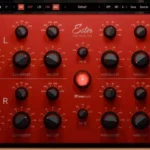
ESTER front panel – logo, MID CUT frequency scale, HIGH-PASS filter, and HIGH BOOST grid. Five filters per channel – LOW CUT, LOW BOOST, MID CUT, HIGH BOOST, and HIGH CUT – each with its own graduated scale. The frequency selectors are true rotary switches that lock onto the graduated marks and don’t move between them, so your favorite setting will return again and again. The sweeps are wide and smooth, designed to balance the mix rather than accentuate it.
Five filters, one network
. Mastering one filter is only half the battle. In a passive equalizer, the sections share a common network, so the curve you get from all five sections simultaneously isn’t the sum of the curves from each section individually. Change one, and the others change along with it, and it’s this interaction that determines the sound of such an equalizer. ESTER preserves both principles: each filter on its own and the entire curve they form together faithfully replicate the original. And this sound is the sound of the entire device, not just the passive network—the quiet, linear sound of the amplifiers and transformers is part of it—and the voice that emanates from it belongs to ESTER.
Low frequencies, both in the same direction
LOW BOOST increases the level by up to +16 dB at frequencies of 20, 40, 60, 100, or 140 Hz. LOW CUT reduces the level by up to -18 dB at frequencies of 30, 40, 100, or 400 Hz. These are two controls for a single passive network, and the classic technique is to use them together: boost and cut pressure in the same region, creating weight below it and a void above it. No single shelf can do this.
MID CUT—a place for everything else
Up to -16 dB at frequencies of 200, 300, 400, 500, 600, or 700 Hz. The curve is wide, so two to three dB opens up the entire midrange rather than leaving a hole. When combined with LOW BOOST, this is the oldest technique in this type of equalizer: boosting the low frequencies and cutting the highs.
- Download Lemur Audio – ESTER v 1.0.0 VST3, AAX x64 [09/14/2026](R2R)
- Original Publisher: Lemur Audio
- Version: v1.0.0
- Format: VST3, AAX
- Category: VST Plugins
- Require: Windows 10+ & R2R System
- License type: Full
- Download Size: 48.9 MB