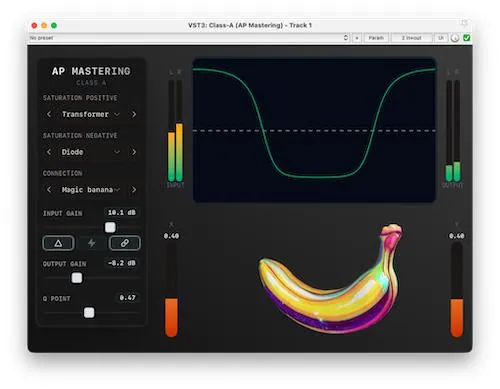
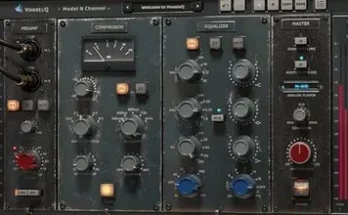
Vintage mic pre and magical banana simulator.
Features
- Does stuff similar to vintage class-A mic preamps
- Asymmetric saturation introduces even order harmonics
- Saturation type can be selected individually for positive and negative sides
- Visualisation of saturation processing using intuitive low frequency sine wave
- Magical banana
- Trout-derived 3D waveshaping distortion
Class A amplifiers are named after the amplifier design historically used in many vintage amplifiers and preamplifiers (such as the Neve 1073). Single-ended Class A amplifiers are often associated with expensive analog gear, but there’s no reason you can’t achieve the same thing with modern equipment without breaking the bank. In fact, many modern electronic devices operate using the Class A principle. There’s nothing stopping you. But one of the reasons people have abandoned this design is that it’s very inefficient and wastes energy as heat.
Why does this happen? It’s all about the DC bias voltage, which is used to convert an AC signal into DC electrical components. Instead of setting the zero-crossing point for our audio signal to zero, we set a non-zero voltage to shift the signal upward and prevent it from going negative. It remains positive at all times, say, between 0 and 10 volts. So, our new zero-crossing point for the audio signal is now 5 volts. This is called the Q point, short for “quiescent point.” But this means that even with no input signal, the amplifier still produces half its electrical power, which is wasted, turning into heat. Fortunately, plugins can simulate exactly the same processes in the digital domain without wasting so much power.
Well, this is a bit of a geek thing, and you don’t need to know all of it. You can simply experiment with a plugin that does something similar and, as a result, create different types of rich harmonics… different types of odd and even harmonics depending on the degree of saturation of the positive and negative sides and the Q-factor. The higher the Q-factor and the more asymmetrical it is, the more even-order harmonics you’ll get.
It’s important to note the following… while some mastering engineers believe they can make the sound richer by running it through an XLR cable, the truth is that XLR cables don’t affect the sound at all. So, if you select an XLR cable, which is actually the default connection type, and try moving it around, you’ll hear a disappointing result… nothing will change. Because, contrary to popular belief, XLR cables are completely transparent. And while this may be disappointing, this plugin accurately models real-world objects.
For those interested in learning more about Class A preamp theory, particularly the design of the Neve 1073, I’ve made a video on the topic.
- Download AP Mastering – Class-A v3.0.0 VST3, AAX x64 [2.10.2026](R2R)
- Original Publisher: AP Mastering
- Version: v3.0.0
- Format: VST3, AAX
- Category: VST Plugins
- Require: Windows 10+
- License type: Full
- Download Size: 36.6 MB

only banana I like is the one that goes up my tail pipe